Back again with the news corner, this is Chubby mom’s correspondent! Today, we’re going to look into the connection between Tylenol (ingredient name: acetaminophen) and autism, as well as the new policy direction in the United States that President Trump recently announced himself.
Since President Trump, along with the U.S. Department of Health and Human Services (HHS) and the FDA (Food and Drug Administration), directly announced that “taking Tylenol during pregnancy may be related to autism in children,” this topic has been drawing huge global attention. But does taking Tylenol during pregnancy really increase the risk of having a child with autism? Let’s take a closer look at the correlation between Tylenol and autism, the research so far, government policies, and expert opinions one by one!

Below is a table of contents that lets you jump straight to the section you want to read with just one click, so feel free to use it!
[목차]
Research from the Past 10+ Years (Acetaminophen and Autism)

Over the past decade, several studies have reported that the use of acetaminophen during pregnancy may be linked to neurodevelopmental disorders such as ASD (Autism Spectrum Disorder) and ADHD (Attention-Deficit/Hyperactivity Disorder). For example, statistical associations have been found suggesting that when pregnant women frequently or for long periods used Tylenol, their children had a higher likelihood of showing developmental issues.
However, an important point is that most of these studies are observational studies. Observational studies compare “groups that took the drug and groups that didn’t” using real patient data, but it’s difficult to perfectly control for differences between the groups. For instance, the reasons why pregnant women took Tylenol—such as high fever, infection, or inflammation—may themselves have significantly affected fetal development. In other words, it’s hard to clearly determine whether the cause was the medication itself, or the underlying condition that required taking it.
Large-Scale, Rigorous Study (Acetaminophen and Autism)

One of the most reliable studies on the association between acetaminophen and autism or ADHD (Attention-Deficit/Hyperactivity Disorder) was a nationwide cohort study conducted in Sweden, published in April 2024. The cohort included 2,480,797 children born between 1995 and 2019, who were followed until December 31, 2021. The researchers also performed a sibling-control analysis. The results were as follows:
| Comparison Type | Findings |
| Simple Comparison | An association was observed between Tylenol use and autism/ADHD |
| Sibling Comparison | The association between Tylenol use and autism/ADHD disappeared |
In other words, within the same family, when the mother used acetaminophen during one pregnancy but not another, there was no difference in autism risk between the siblings. This suggests that genetic or environmental factors, rather than acetaminophen itself, may have played a larger role in the development of autism.
What Is the Actual Risk of Autism? (Risk Figures)

According to the U.S. CDC (Centers for Disease Control and Prevention), the prevalence of autism in children is about 3.2%, or roughly 1 in 31 children. However, the increase in risk suggested by studies was only about 0.02%. In other words, if the baseline risk is 3.2%, it would rise only to 3.22%, which falls within the margin of statistical error.
Therefore, based on current evidence, it is difficult to conclude that “taking Tylenol significantly increases the risk of autism.”.
President Trump and the FDA Policy Announcement (September 22, 2025)
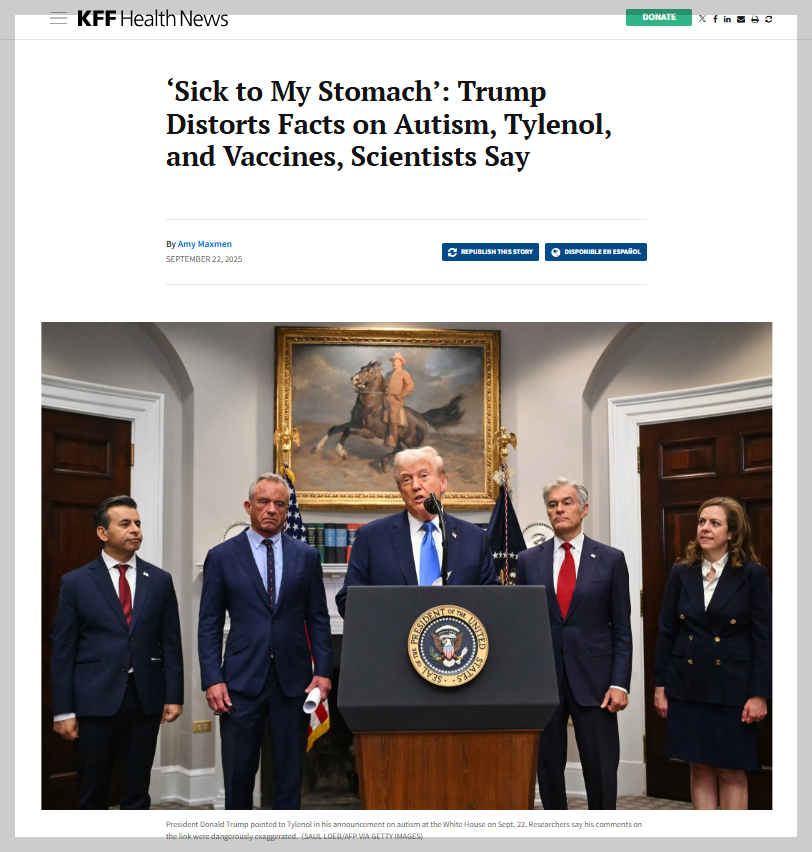
Although the actual data so far does not allow us to conclude that acetaminophen products such as Tylenol significantly increase the risk of autism, the U.S. government has nevertheless announced precautionary safety measures.
In September 2025, President Trump, the HHS (Department of Health and Human Services), and the FDA (Food and Drug Administration) held a joint press conference to announce new policies regarding acetaminophen. The main points are summarized below.
| Key Point | Description |
| Start of acetaminophen product label changes | Review initiated for adding warning statements related to use during pregnancy |
| Official notification to physicians | Guidance for doctors to inform patients during consultations |
| Expansion of research investment | Increased NIH (National Institutes of Health) funding and state program support for studies on autism causes and treatments (e.g., metabolism-related therapies such as leucovorin) |
In other words, the U.S. government clarified that this does not mean acetaminophen products like Tylenol are “scientifically proven 100% to cause autism.” Rather, these steps are precautionary measures taken in response to potential, but uncertain, risks.
Reactions from Experts and Medical Societies

However, experts have a slightly different perspective. The American College of Obstetricians and Gynecologists (ACOG) immediately issued a statement emphasizing that
“There is still insufficient scientific evidence that acetaminophen directly causes autism. Moreover, failing to treat high fever or severe pain during pregnancy can pose a greater risk to fetal health, so unnecessary fear should not be promoted.”
In practice, doctors say that it is more important to use medication in the safest way when needed, rather than telling pregnant women to completely avoid taking any medicine.
So, What Should Pregnant Women Do?

1. There’s no need to completely avoid Tylenol or similar medications.
Avoiding medicine when experiencing high fever or severe pain can itself be harmful to the fetus. For example, high fever may increase the risk of neural tube defects or preterm birth.
2. Take Tylenol or similar medications only when truly necessary.
Mild fevers can often be managed with non-medication methods such as rest and staying well-hydrated. However, high fever or extreme pain must be treated.
3. Follow the principle of “lowest effective dose for the shortest possible time.”
Both the FDA and CDC recommend using the minimum dose needed to achieve the effect, for the shortest duration possible.
4. Always consult a doctor.
Individual health conditions, underlying illnesses, and other medications being taken can all affect what is safe and appropriate.
Summary

So far, studies show signals that there may be a link between taking Tylenol and autism, but they do not fully prove causation.
The U.S. government is taking precautionary measures by reviewing warning labels and expanding research, while experts emphasize the need for a balanced perspective rather than fear. Pregnant women are advised to follow the principle of “lowest effective dose for the shortest possible time” and consult their doctor, taking medication only when truly necessary.
Today, we explored the hot topic of Tylenol (acetaminophen) and its potential association with autism, as well as the new policies announced by President Trump and the U.S. government. We hope this has been helpful for everyone curious about the issue.
That’s it for today’s post—Bye!!