Back again in the news corner, this is Chubby mom’s correspondent. Just a few days ago, I came across the news that Jane Goodall, the world-renowned ethologist known as the “Mother of Chimpanzees,” has passed away. Since she was such a famous figure who made a global impact, I would like to share who Jane Goodall was, what her achievements were, what influence and lessons she left for us, and how she passed away.

Below is a table of contents that lets you jump to the section you want with just a click, so please use it for your convenience.
[목차]
Who is Jane Goodall? Jane Goodall’s Profile
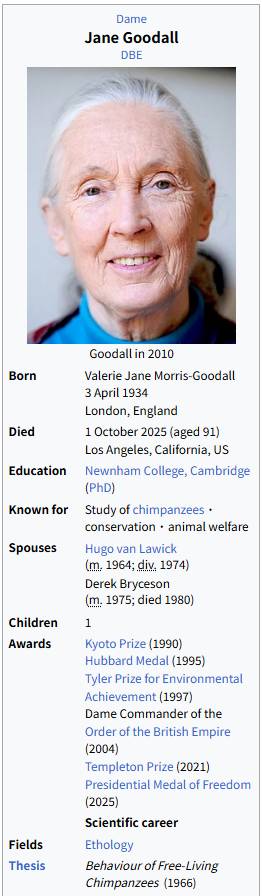
Jane Goodall (full name: Valerie Jane Morris-Goodall) was born on April 3, 1934, in London, England. She was a zoologist and environmental activist. Jane Goodall graduated from high school in 1951, and in 1956, at the suggestion of a friend, she traveled to Kenya. There she met Louis Leakey, the renowned archaeologist and anthropologist of the time, who greatly influenced her path.
In 1960, at Leakey’s suggestion, Jane Goodall set out for Africa with her mother, Vanne Goodall, who accompanied her as guardian, to study chimpanzees. She conducted her research in Gombe National Park (then the Gombe Chimpanzee Reserve). In 1964, she married Hugo van Lawick, a talented wildlife photographer sent by National Geographic. In 1965, with Leakey’s support, she was awarded a Ph.D. from Cambridge without first earning a bachelor’s degree.
In 1974, due to irreconcilable differences and frequent conflicts, she divorced Hugo van Lawick. Later, she married Derek Bryceson, who was the director of Tanzania’s national parks and a member of parliament in Dar es Salaam. From 1986 until 2025, during her lifetime, she carried out lectures and campaigns worldwide dedicated to animal protection. On October 1, 2025, Jane Goodall passed away from natural causes in Los Angeles, California, at the age of 91.
Jane Goodall gained worldwide recognition through her chimpanzee research in Tanzania’s Gombe Stream National Park beginning in the 1960s. She is well known for having devoted more than half of her life to environmental protection and the advancement of animal welfare.
Jane Goodall’s Achievements – Chimpanzee Research and Animal Protection Movement
As explained in her profile, since 1960 Jane Goodall observed the social behavior and ecology of chimpanzees in Tanzania’s Gombe Stream National Park, conducting research that blurred the boundaries between humans and animals. Her most groundbreaking discovery was that chimpanzees use tools. This revolutionary finding overturned the prevailing scientific belief that only humans were capable of tool use. Her studies on the complex social structures of chimpanzees, their emotional expressions, and cooperative hunting demonstrated remarkable similarities to humans, opening a new chapter in ethology. In 1965, she earned her Ph.D. in ethology from the University of Cambridge, an extraordinary case achieved without a bachelor’s degree, which further emphasized the depth and credibility of her research.
Jane Goodall also witnessed the decline of chimpanzee populations as human population growth led to deforestation, land cultivation, and the hunting of chimpanzees for bushmeat in Africa. In response, she visited laboratories and research centers to engage in discussions with scientists and administrators, campaigned and lobbied for chimpanzees living in poor conditions, and gave a series of lectures worldwide. Through these efforts, she influenced both policymakers and the global public, raising awareness of the importance of animal protection. (Source: https://en.wikipedia.org/wiki/Jane_Goodall)

Jane Goodall received numerous awards in recognition of her achievements, published several books on related subjects, and in addition to her doctorate from the University of Cambridge, she was also awarded multiple honorary doctorates from other universities.
Jane Goodall’s Influence
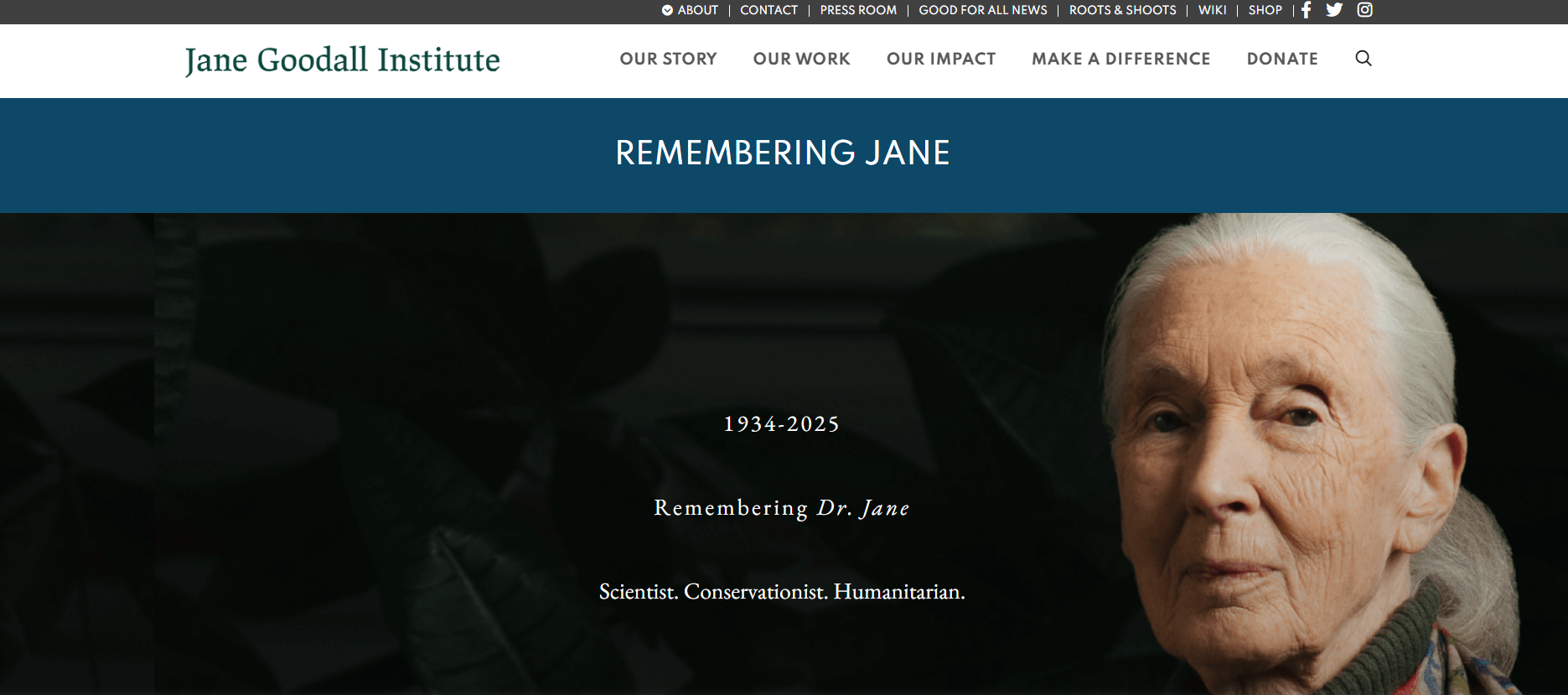
Jane Goodall’s research went beyond scientific discoveries and contributed to redefining the relationship between humanity and nature. In 1977, she founded the Jane Goodall Institute, which has continued to support chimpanzee conservation and research. In 1991, she launched Roots & Shoots, a youth environmental education program that has since expanded to over 100 countries worldwide.
Her work has spanned a wide range of fields, including environmental protection, animal welfare, and sustainable development. She was appointed a United Nations Messenger of Peace, helping to raise global awareness of environmental issues. She also delivered messages of hope and action through her podcast, Hopecast, and continued her advocacy even during the pandemic without pause.
Jane Goodall’s Death and Legacy
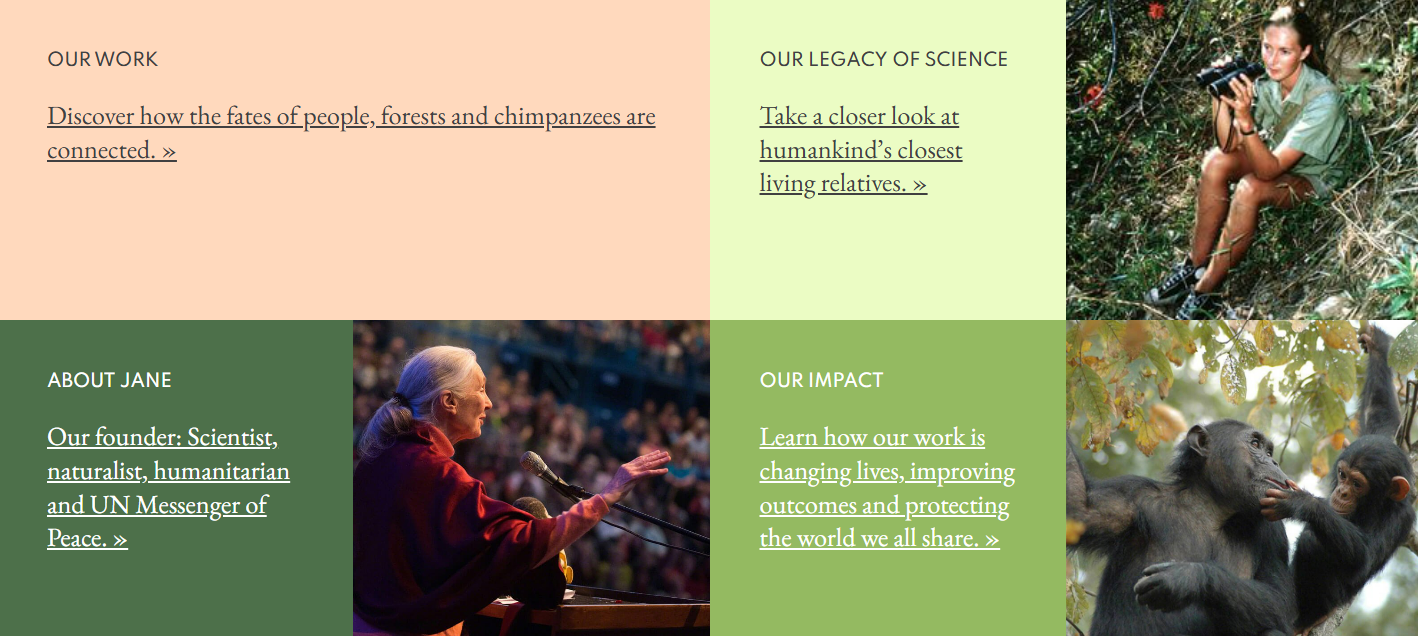
Jane Goodall continued her efforts to protect the environment and improve animal welfare until the very end of her life. Just about a week before her passing, on September 24, 2025, she attended the Bloomberg Philanthropy Global Forum in New York, where she gave a speech on the importance of the environment and youth. On October 1, 2025, she passed away from natural causes in Los Angeles, California.
Her legacy extends far beyond her scientific achievements. Jane Goodall inspired countless people around the world to pursue harmonious coexistence with nature, respect for animals, and meaningful action toward a sustainable future. Her life and philosophy will continue to inspire many and remain at the heart of efforts for a sustainable planet.
Today, we explored the life of Jane Goodall, famed for her chimpanzee research and activism in animal protection. Her life went beyond that of a typical researcher; it was a journey toward harmonious coexistence between humanity and nature. Jane Goodall’s achievements and influence will continue to resonate worldwide, and her spirit will live on in the hearts of all of us.
That concludes today’s blog post.